




Doctor Who:The Movie The Night of the Doctor The Power of the Doctor 
The Doctor - Paul McGann The Master - Eric Roberts Grace Holloway - Daphne Ashbrook Chang Lee - Yee Jee Tso 

OTHER DOCTORS Tom Baker Christopher Ecclestone David Tennant Matt Smith Peter Capaldi Jodie Whitaker Ncuti Gatwa SPIN OFFS Torchwood The Sarah Jane Adventures Class K-9 The War Between The Land And The Sea TIME TRAVEL SHOWS Timecop Life on Mars Ashes to Ashes Journeyman Daybreak Goodnight Sweetheart The Flipside of Dominick Hyde
|
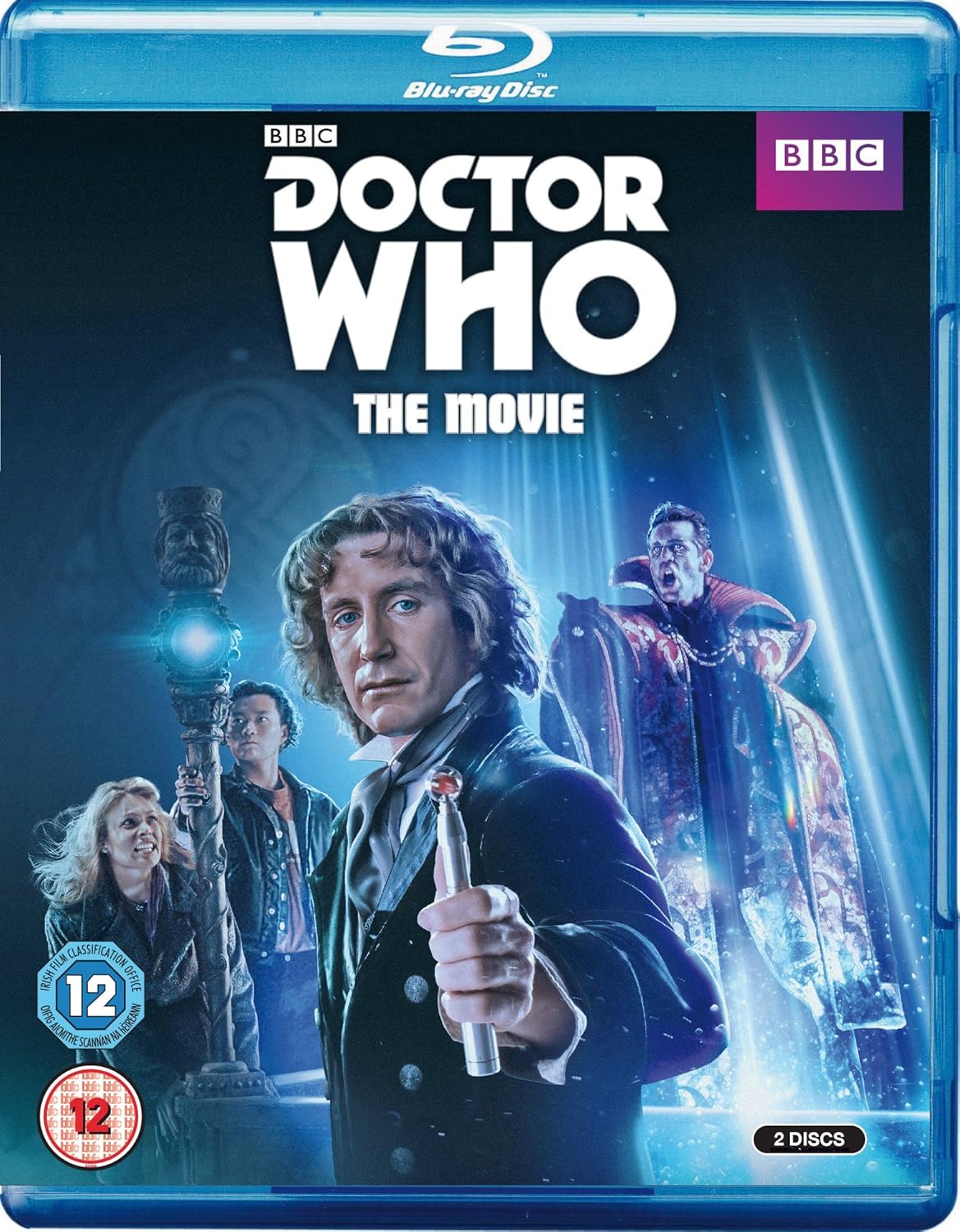
DOCTOR WHO:THE MOVIE first transmitted May 27th 1996The Master is dead, his last life snuffed out on the planet Skaro. His last request was for his remains to be returned to his home planet of Gallifrey by his long-time nemesis, The Doctor. When things go wrong mid-flight, the Doctor must make an emergency landing on planet Earth. There he is shot, and the exploratory surgery finishes the job, killing him. Except the Doctor is a Time Lord, a being with two hearts who can regenerate into a new body a limited number of times. This is the Master's plan, his essence now inside the body of an paramedic, to steal the Doctor's remaining lives. To do it, he must open the Eye of Harmony at the heart of the Tardis, an act that could spell the end of the entire planet, unless the Doctor can find an atomic clock to restore balance to the Tardis before the stroke of midnight and the start of the new Millennium. The BBC's flagship science fiction show is in the habit of reinventing itself, very much like the Time Lord it features. The main character's regeneration was invented simply to allow the show to survive past the failing health of its first actor. Each Doctor brings a new iteration and each writing/producing team puts their own stamp upon it. It was therefore inevitable that the cancelling of the show in 1989 would not be the end. In 1996, a feature length pilot was produced by the BBC in conjunction with Universal Pictures. To review it properly, we must consider it through both the reaction of its time and through the lens of the modern show, which it not only predated, but in many ways paved the way for. DOCTOR WHO:THE MOVIE was successful in terms of audience in the UK, but its reception by critics and fans was mixed and that reception is fair because this outing for the Eighth Doctor gets a lot of things right (many of which were continued with the return in 2005), but what it gets wrong it gets wrong in a big way. We must begin, as we always should, with the Doctor. Paul McGann is excellent in the role of the new Time Lord. He is young and has leading man looks, topped with a mass of curly hair that makes him the most visually appealing Doctor to date, but he also has the intensity for the role. To begin with, he has to deal with the confusion of a bad regeneration, made worse by human surgical intervention, not knowing who he is. As his memories start to return, however, he becomes a Doctor we can accept, embodying the unpredictably, intelligence and humanity of the incarnations that came before him. He delivers the dialogue at a rapid pace, something that would become a hallmark of the show's rebirth nearly a decade later, and shoots off on tangents at a moment's notice. He is full of the joie de vivre and energy of newly-regenerated Doctors. He is, in short, exciting and has a motorcycle chase to prove it. Had the follow up show materialised, he would probably have been amongst the greatest of Doctors. The film itself is part reboot and part continuation of the story. The presence of Sylvester McCoy makes it very clear that this is a straight sequel to the show's last episode. There are many callbacks to what has gone before, something that both aids and hinders the success of the show, especially in the overseas markets where the character and thbe lore of the show were not well known. Jumping into a story mid-point is always difficult and virtually no quarter is given to people who have never heard of Time Lords before. The opening monologue is almost as opaque as the one at the start of David Lynch's DUNE, turning away potential audience members right from the off. Those familiar with the show will also find plenty to gripe about. For a start, the Eye of Harmony that powers the Tardis is already known to be the power source that resides beneath the Panopticon on Gallifrey, not in the Doctor's transport. This would have been fine in a straight reboot, but is a sloppy mistake to make in a continunation of the story. And then there is the cardinal sin the film makes of trying to suggest that the Doctor is half-human. Sure, the half-human character of Spock in STAR TREK might make this seem like a good idea, and it would certainly explain the character's fondness for the Earth, but the lore has firmly established that the Doctor is as Time Lord of Gallifrey and not half-human at all. That one assertion alone was enough to bring howls of anger from the fans. There is also no explanation for why the power source of the Tardis can only be opened by the eyes of a full human. Even if the Doctor was half-human (which he isn't) the Time Lords would not equip their Tardises with a uniquely human-powered locking device. This makes precisely zero sense. Continuity issues aside, there is much to like about this outing. Firstly, it looks better than the show had ever looked. It is directed and photographed with a real cinematic eye that is light years away from the studiobound interiors and outside broadcast quality of the classic series. The interior of the Tardis is a wondrous sight, very much a Wellsian study in flight. This set presages the control rooms that would feature in the 2005 reboot with their gloomier, retro feels, whilst also harking back to the wooden control that appeared for a while in the reign of the Fourth Doctor. The post-regeneration scenes where the Doctor roams through the unconstructed part of the hospital wrapped in his shroud, crying that he doesn't know who he is, is full of weird angles and shots, deliberately playing on the iconography of a resurrected Jesus and the reborn creature from Frankenstein. This point is somewhat hammered home by the original film being shown on the TV in the morgue workers' office. The effects are sparing (an ephemeral snake master that looks fine, but doesn't really make sense), but pretty well done. The pacing is pretty much spot on throughout. The casting also works in the show's favour. Set in the USA (though shot in Canada) in order to win American audiences that can't imagine anything of importance happening anywhere else in the world, it necessarily features actors from across the pond. Eric Roberts plays the Master as a cartoon villain, which is not out of line considering the old enemy's appearances in the classic show, with a touch of camp and a lot of menance. A more nuanced performance would have been welcome. Daphne Ashbrook is excellent at Grace Holloway, a new kind of companion. A world-class surgeon with principles, she is smart and successful and isn't at all freaked out by the Tardis being bigger on the inside, instantly grasping the potential scientific principles at work. She is sceptical at first, but is gradually won over by the force of nature that is the Doctor's arrival in her life, breaking out of a constricting life into something new. She is also the very first companion who gets to kiss the Doctor. Much was made of this at the time of the movie's first showing, but the kisses are somewhat chaste and nothing at all to be concerned about in the light of the relationships between Time Lord and companions in the later era. This is one of the more obvious ways in which the movie previewed what was to come. Yee Jee Tso is also welcome as a young companion who straddles the good and the bad by stealing the Doctor's property and taking up with the Master whilst having also saved the Doctor's life. Though he comes good at the end, he is pleasingly materialistic. DOCTOR WHO:THE MOVIE is a transition point between the classic series and the new era and it is easy to mock the errors made in the continuity of the piece, but lt clearly shows exactly what is possible if the show was to be taken seriously and given a budget just as serious. The fact that the new era echoes it in so many ways suggests that all fans should re-evaluate it and appreciate the unique position it holds in the history of everyone's favourite Time Lord. Top THE NIGHT OF THE DOCTOR transmitted November 16th 2013The Eighth incarnation of the Doctor has been unsuccessfully fighting in the Time War. He has become a figure feared by many that he is trying to save. When his latest act of heroism fails because of who he is perceived to be, he determines that it is time for a new kind of Doctor to emerge. A mini-episode created for the fiftieth anniversary celebration, The Night Of The Doctor sees Paul McGann return to the role, if only to fill in the gap between his incarnation and that of John Hurt, seen briefly at the end of The Name Of The Doctor. This is an unashamed gift to the long-time viewers of the show and will have little significance to those who weren't watching when McGann made his only appearance in the abortive attempt to reboot the show back in 1996. That said, it is lovely to see what might have been as he gets another outing. There is absolutely no doubt that he would have been a great Doctor and the proof is here. Short it may be, but there is an awful lot of Doctorly goodness packed in there. The sets are excellent, the plot is compact and, due to the short running time, lean and mean and one of Moffat's better efforts. It bodes well for the upcoming fiftieth anniversary special Top THE POWER OF THE DOCTOR transmitted October 23 2022After attempting to foil a cyberman attack on a bullet train in outer space, the Doctor finds herself assailed by a number of simultaneous attacks. In 1916 Russia, a new planet is in the sky and Rasputin controls the court, in 2022 a rogue Dalek offers to provide the secret to destroying all the Daleks, whilst UNIT struggles with the defacing of the world's most most famous paintings and the kidnap of the worlds leading seismologists. Are these random issues or could the Daleks and Cybermen be working together. Even worse, could there be another, more diabolical mind pulling all these strings? The end of a Doctor's reign is always a special time and, in recent years at least, calls for something very special from the writers. With showrunner Chris Chibnall's record being somewhat spotty writing from Jodie Whittaker's groundbreaking Doctor (yes, she's female and she's leaving, so the haters can really get over it), hope was possibly a bit higher than expectations, but against those expectations, he has managed to pull off a worthy, if not perfect, finale. You could certainly accuse The Power of the Doctor of throwing everything at the wall and hoping something sticks, but bringing together the always popular Daleks, with the now-regenerating Cybermen and throwing in Sasha Dhawan's Master provides a powerful troika to give the Doctor her ultimate face off. Unfortunately, it does leave the Daleks with little to do, making them feel like a bit of a sideshow. Their volcano blowing antics may be a call back to THE Dalek INVASION OF EARTH 2150AD's mining shenanigans, but pretty much any of the other races could have carried out that part of the plan. Still, the rogue Dalek offering up the destruction of his whole race is a new wrinkle, even if it is somewhat thrown away. Better served are the Cybermen, with Chibnall not only keeping the regeneration power he gave them in The Timeless Children, but making that a central part of the plot's resolution. It's a clever move and the best bit of plotting in the whole piece. Sasha Dhawan is back as the Master and is as manic as ever, but the scheme he is given is one of the best yet and really fits the mindset of the Master. Add to that his disguise as Rasputin, which just really, really makes sense and a musical number to Boney M and this is absolutely his best role under Chibnall and Dhawan's best performance. And whilst we're piling on the bad guys, we might as well match them with companions. Yaz and Dan are present, of course, though Dan's early departure sets the tone and scene for a more significant parting later on. UNIT's back and that means Jemma Regrave as Kate Stewart, but she's got support from old handers Sophie Aldred as Ace and Janet Fielding as Tegan Jovanka. They get relationship closure with their Doctors via a Tardis operated AI hologram system, which is a nice touch, but Chibnall then finds a way to bring back David Bradley, Colin Baker and Paul McGann as well as Peter Davison and Sylvester McCoy for cameo appearances. Even Jo Martin's Fugitive Doctor is smuggled in. It may sound like it's all a bit too much fan service to stuff into a single episode, but the feature length running time and the clever plotting manages to find space for them all. And that's before the nice little touch of a Companion support group that gives us glimpses of Bonnie Langford, Katy Manning and William Russell. In terms of a casting callback, there's never going to be any way to top that. Not all of the plotting works quite so well. The alien power creature that masquerades as a child is a throwaway plot device, as is the reappearance of Jacob Anderson as Vinder, who is given precisely nothing to do at all. There's no explanation of why the Master sets up his Cyberplanet in 1916 Russia, apart from wanting to do the whole Rasputin thing. There is also no reason for the Master to give himself up and mastermind the attack on UNIT headquarters; it does nothing to advance his plot for personal revenge on the Doctor. There's also no explanation of how Tegan can drop from halfway up the inside of a tall building to escape gunfire and not end up as a pulped mess on the basement floor so far below. These, though, are quibbles in the face of so much to like. And the pace rattles along with its usual speed to skip over the cracks and holes and bare bits. There is, however, one bit that can't be skated over. The Doctor's time is up and she's going to have to say goodbye to Yaz, having finally declared her love for her companion. This forced love interest has never rung true and has always felt forced in for no readily apparent reason. This farewell might have given us that reason at last. Parting is such sweet sorrow and the parting of these two is given all the time and power that the previous relationship never was. This brings home the fact that the Doctor is going and an era is ending. It's not really enough to justify the lacklustre love story that went before it, but it does give the regeneration some punch. A Doctor's farewell is one of their most important moments and both Chibnall and Jodie Whittaker give it their best shot. She was always the Doctor, from her first utterance of "brilliant" (oh shut up and go away, haters), even though she wasn't always given the best writing to prove it. Here, though, her departure scenes are strong enough to stand proudly alongside those of other incarnations. Tag, Doctor whoever-she's-going to be. You're it indeed. And if you managed to avoid all the spoilery rumours and announcements to this point, there's a treat of a twist in store. Top |